

By The Adventure Hut | Nagpur's Outdoor, Tactical & Wildlife Gear Store Since 2014
For wildlife photographers. Bird watchers. Forest travellers. Nature enthusiasts. This one's for you.
You've booked your safari at Pench, Tadoba, Corbett, or Bandipur. You've got your camera. You've got your lens. You're excited.
And then someone asks: "What are you going to wear?"
Most people shrug and grab whatever's in their wardrobe. A bright blue t-shirt. White sneakers. A neon orange cap.
And then they wonder why the deer spooked before they could get the shot.
Wildlife encounters don't give second chances. The right clothing and gear doesn't just make you more comfortable — it determines whether the animal stays or runs. Whether you get the shot or don't. Whether you hear the bird before it disappears into the canopy.
This guide is built for Indian conditions — the dust of Vidarbha, the humidity of the Western Ghats, the early morning chill of Corbett in November, the scorching midday heat of Tadoba in May. Everything recommended here is available at The Adventure Hut, trusted by outdoor enthusiasts across India since 2014.
The Golden Rule: Blend In, Shut Up, Slow Down
Before we talk gear, understand the principle behind it.
Animals react to three things from humans: colour, sound, and movement.
You can't always control movement. You can control sound (mostly). But colour is 100% in your control — and it costs you nothing to get right.
In the wild, bright colours signal danger to most animals. White is universally alarming. Neon anything is a disaster. The colours that let you disappear into an Indian forest are:
- Olive green — matches mixed forest foliage year-round
- Khaki / tan — perfect for dry deciduous forests and grasslands
- Brown camouflage — ideal for rocky, scrub, and winter-dry forest terrain
- Forest camouflage — dense green and brown mix for monsoon and wet forests
- Grey — works in rocky terrain and dawn/dusk light
Everything else — avoid.
Part 1: Clothing — What to Actually Wear
Full Sleeve is Non-Negotiable
Indian forests have three enemies for your skin: mosquitoes, thorns, and sun. Full sleeve shirts handle all three. Don't let anyone tell you full sleeve is too hot — the right fabric makes full sleeve cooler than half sleeve in direct sunlight because it blocks UV from hitting your skin.
Our top picks for wildlife use:
Army Brown Camo Full Sleeve Combat T-Shirt (Rs. 999) The brown camouflage pattern is specifically ideal for dry deciduous forests — Pench, Tadoba, Bandhavgarh, Kanha. In these habitats, the brown-and-tan camo blends perfectly with leaf litter, dry grass, and bare branches. Full sleeve protects arms completely. Heavy cotton construction means it handles thorny undergrowth without tearing.
Camouflage ADV-BGK Full Sleeve T-Shirt (Rs. 999) The multi-tone green-brown camouflage pattern works excellently in moist deciduous and semi-evergreen forests — Corbett, Kaziranga, Goa's wildlife areas. If you're doing northeastern India birding trips (Assam, Arunachal), this pattern is a perfect match for the dense vegetation.
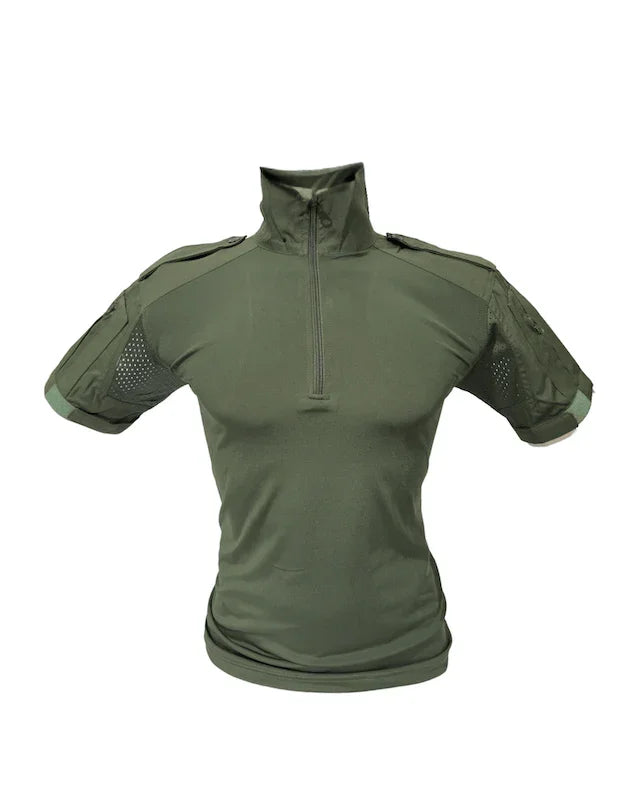
6-Pocket Tactical Combat Shirt — Olive Green Half-Zip (Rs. 1,199) This is arguably the most functional wildlife shirt we stock. Six pockets eliminate the need to carry a waist pouch — keep your lens cloth in one, memory cards in another, insect repellent in a third. The half-zip collar allows ventilation control. The mesh back panels breathe exceptionally well during long forest walks. Olive green is the universal forest colour that works across every Indian habitat.
Green Airborne Dry Cool T-Shirt (Full Sleeve) (Rs. 649) For peak summer safaris — Tadoba in April-May, or Pench in the height of summer — quick-dry performance fabric is essential. This shirt pulls sweat away from your body and dries within 20 minutes. It won't feel heavy or drenched even after a 4-hour morning safari. The olive green colour works in forest environments.
The Colour Test: Before You Pack
Hold each piece of clothing up against a photo of your destination's vegetation. Does it disappear into the background or stand out? That's your test. If it stands out — leave it at home.
Part 2: The Gear That Makes or Breaks Your Safari
Binoculars — The Single Most Important Piece of Non-Camera Gear
You will see 10 animals through binoculars for every 1 you can photograph with a telephoto lens. Binoculars let you identify a bird at the top of a 30-metre teak tree. They let you track a leopard moving through grass 400 metres away. They let you scan a waterhole from distance without disturbing the animals at it.
Do not underestimate binoculars. Most wildlife enthusiasts who skip them regret it instantly.
Here's what the numbers mean:
- 7x30 — 7x magnification, 30mm objective lens. Compact, lightweight, wide field of view. Best for general forest use and bird watching where birds are moving fast and you need to acquire them quickly.
- 8x42 — 8x magnification, 42mm objective lens. The professional standard for wildlife observation. The larger lens gathers significantly more light — crucial for dawn and dusk when most wildlife is active. Recommended for serious bird watchers and wildlife photographers.
- 10x50 — 10x magnification, 50mm objective lens. Maximum magnification for long-distance scanning — waterholes, open grasslands, distant tree lines.
Our binocular range:
7x30 Binoculars — Camouflage (BAK4 Prism) (Rs. 1,199) The camouflage finish is specifically designed for wildlife use. BAK4 prism glass delivers high light transmittance (over 99.5%) — bright, clear images even in low forest light. Wide-angle design lets you sweep across a tree canopy quickly. Compact and lightweight — ideal for day-long use in the field without fatigue. Tripod-adaptable for long observation sessions.
7x30 Binoculars — Blue (Waterproof, Nitrogen-Filled) (Rs. 1,199) The nitrogen-filling makes this model completely fog-proof — essential for early morning safaris when temperature drops cause condensation on optics. Close-focus distance of approximately 2 metres makes it excellent for garden bird watching as well. Waterproof construction handles monsoon forest conditions.
8x42 Binoculars — Green (BAK4, Multi-Coated) (Rs. 1,399) The professional choice. Fully multi-coated optics with large 42mm BAK4 prism lenses deliver the brightest, sharpest images in our range — and critically, they perform excellently in weak light conditions. Dawn tiger sightings and dusk leopard activity are exactly where this binocular earns its price. Aspherical lenses eliminate the edge distortion common in cheaper binoculars. Adjustable eyecups for comfortable extended viewing. Tripod-adaptable.
10x50 High Magnification Binoculars (Rs. 1,399) For open habitat use — Velavadar blackbuck sanctuary, Little Rann of Kutch, Bharatpur wetlands. 168m field of view at 1000m. Multi-layer coated aspherical lenses with minimal distortion. If you're scanning large open landscapes for distant subjects, this is the binocular to carry.
Which binocular to buy for your destination? Dense forest (Corbett, Tadoba, Kanha) → 7x30 or 8x42 Open grassland / wetland (Bharatpur, Velavadar) → 10x50 General all-purpose / bird watching → 8x42 Green
Browse Binoculars: theadventurehut.in/collections/binoculars
The Tactical Backpack — Your Moving Base Camp
A wildlife photographer or bird watcher in the field carries more than just a camera. Water, snacks, binoculars, extra lenses, lens cloths, insect repellent, a rain jacket, a notebook, spare batteries. In a safari vehicle this is manageable. On a forest walk or birding trail — you need a bag that distributes this weight properly and keeps everything accessible.
What to look for:
- Earth tone or camouflage colour (not bright orange or red)
- MOLLE webbing for attaching pouches externally
- Hydration bladder compartment — hands-free water is critical on long forest walks
- Rain cover — Indian monsoon is unpredictable and your gear can't get wet
- Padded shoulder straps — you'll wear this for 4–8 hours at a time
- Multiple external pockets — quick access to binoculars, lens cloths, insect repellent
Our recommendation: 45L Military Tactical MOLLE Backpack — Camouflage The MOLLE system lets you attach a binocular pouch to the front for instant access without opening the bag. The camouflage pattern keeps your profile low in the field. Multiple compartments mean camera gear, water, and personal items are organized and separated. Large enough for a full day's kit.
Browse Bags: theadventurehut.in/collections/tactical-bags
LED Headlamp — For Pre-Dawn Starts and Night Safaris
Every serious wildlife enthusiast knows the drill: the best sightings happen in the first and last hour of light. This means arriving at the forest gate before sunrise. Which means getting ready in the dark. Which means you need a headlamp.
A headlamp is also essential for:
- Night safaris (legally permitted in some parks with special permission)
- Reading field guides and checking camera settings in low light
- Camp/lodge navigation after dark
- Birding dawn chorus walks where you're in the field before any light
Our LED Headlamp 4-Pack (Rs. 400) At Rs. 100 per unit, this is one of the best-value outdoor purchases you can make. Hands-free illumination means you can adjust your binoculars, check your camera, or walk a forest trail without fumbling for a torch. Buy the 4-pack — keep one in your safari bag, one at camp, one in your vehicle, one at home. You'll use all four.
Browse Torches & LED: theadventurehut.in/collections/high-performing-torches-led
Paracord Bracelet with Compass & Whistle — The Compact Safety Essential
Forest walks and birding trails carry real risk of disorientation. A single paracord bracelet gives you three genuine safety tools:
Compass — Basic but functional for orientation. In a dense forest where you've lost sight of your vehicle or trail marker, knowing which direction is North can be genuinely life-saving.
Whistle — Carries 3x further than a human voice. Standard international distress signal: 3 short blasts. If you're separated from your group, this gets you found.
Paracord — 3–4 metres of high-strength cord when unravelled. Used to secure a camera strap, lash together an improvised shelter, hang a wet jacket to dry, or in genuine emergencies, for rescue operations.
Paracord Survival Bracelet with Compass & Whistle (Rs. 399) Wear it. Every time you go into the field. It weighs nothing and takes no space.
Multitool — Because Something Always Needs Fixing
On a wildlife trip, something will need fixing or cutting. A camera strap. A backpack buckle. A tent zip. A food pack. The list is infinite. A good multitool handles all of it.
18-in-1 Multitool Pliers (Rs. 999) Stainless steel, locking blades, compact fold. Fits in a shirt pocket or backpack side pocket. Pliers, knife, saw, file, screwdrivers, can opener, bottle opener. On a 5-day wildlife trip, you'll use this at least once a day.
Tactical Cap — Brim, Camouflage, UV Protection
A cap does three things for wildlife observation: blocks sun from your eyes (critical for scanning trees and sky), reduces your facial profile's visibility, and keeps sweat off your face during long walks.
Camouflage Breathable Mesh Tactical Sun Cap (Rs. 350) The breathable mesh crown keeps your head cool in summer heat. The structured camo brim provides substantial sun protection. The camouflage pattern keeps your head profile low in the field. This is the cap to wear for wildlife — not a bright blue cricket cap.
Sunglasses — Polarised for Wildlife Use
Polarised sunglasses are specifically useful for wildlife observation near water. They eliminate surface glare from rivers, lakes, and wetlands — allowing you to see crocodiles, fish, and water birds that would be invisible through glare without them.
Browse Sunglasses: theadventurehut.in/collections/sunglasses
Part 3: The Complete Wildlife Safari Packing List
Clothing
- ☐ Full sleeve camouflage or olive green shirts — 2 per day minimum (you'll sweat)
- ☐ Full sleeve quick-dry shirt (for peak summer safaris)
- ☐ Khaki or olive cargo trousers or trekking pants (no jeans — uncomfortable and loud)
- ☐ Light fleece or full sleeve layer for cold morning drives
- ☐ Camouflage tactical cap
- ☐ Neck gaiter / balaclava (for dusty open vehicle safaris)
Optics & Electronics
- ☐ Binoculars (8x42 for most destinations)
- ☐ Camera + lenses (telephoto is essential)
- ☐ Spare batteries — multiple (forest lodges often have unreliable power)
- ☐ Memory cards — multiple 64GB cards are better than one large card
- ☐ LED headlamp
- ☐ Power bank
Accessories & Safety
- ☐ Paracord bracelet with compass & whistle
- ☐ Multitool
- ☐ Insect repellent
- ☐ Sunscreen SPF 50+
- ☐ Water bottle — minimum 1L; hydration bladder for forest walks
- ☐ Small first aid kit
- ☐ Rain poncho or packable rain jacket
Navigation & Reference
- ☐ Field guide for local birds/mammals (physical copy — no signal in forest)
- ☐ Park map
- ☐ Offline maps downloaded before arrival (Google Maps offline works)
Part 4: Common Mistakes That Ruin Wildlife Sightings
Wearing bright clothing. The single biggest mistake. One person in a red shirt can ruin a sighting for the entire vehicle.
Strong perfume or deodorant. Animals detect scent from enormous distances. Fragrance-free is the rule in the field.
Talking loudly. Sound carries in a forest. Low voices, always.
Using a phone torch. The blue-white LED light of a phone torch is extremely disturbing to nocturnal animals. Always use a warm-toned headlamp.
Wearing noisy fabrics. Nylon and synthetic shells that rustle with every movement are a wildlife deterrent. Choose cotton or soft-finish performance fabrics that move silently.
Skipping the binoculars. Covered above. Never do this.
Where to Get Your Wildlife Gear
At The Adventure Hut, we've been gearing up wildlife enthusiasts, bird watchers, forest photographers, and nature travellers since 2014. Our binoculars, tactical clothing, backpacks, and accessories are specifically selected for real-world Indian outdoor use — not copy-pasted from a Western catalogue.
Everything on this list is available online with pan-India delivery and COD.
📍 Visit our store: Kadbi Chowk, Kamptee Road, Nagpur – 440014 🛒 Shop online: theadventurehut.in 📞 Call / WhatsApp: +91 76668 17070 📧 Email: kanakadventurehut@gmail.com
Related Collections:


0 comments